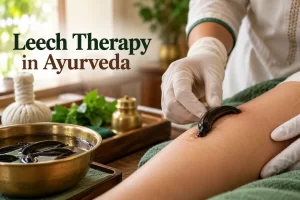

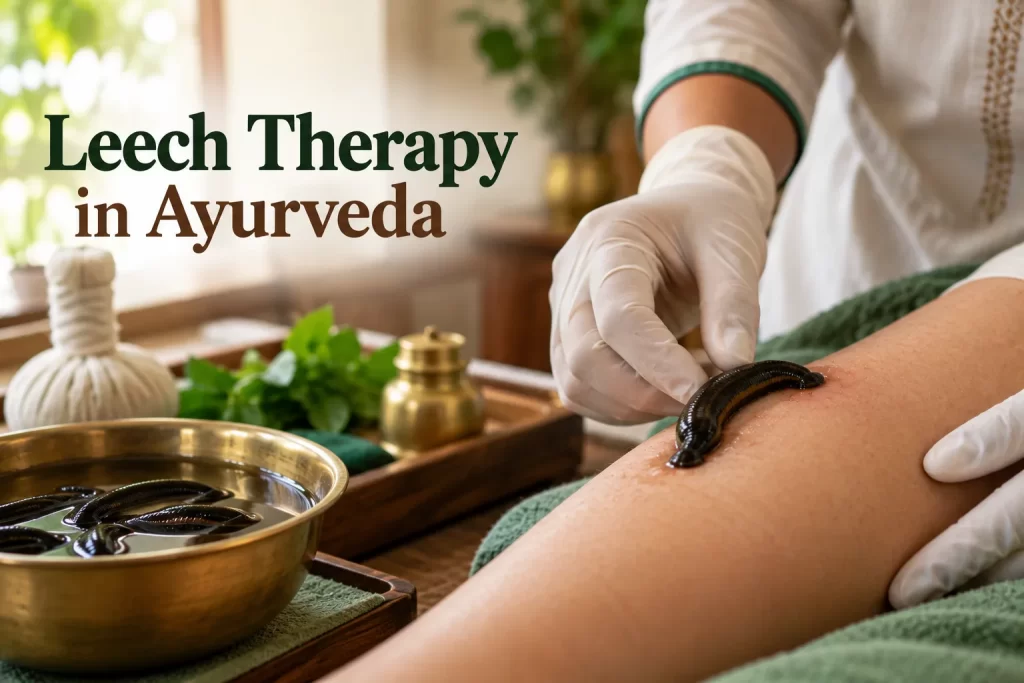
Leech therapy, also known as Hirudotherapy or medicinal leech therapy, is a traditional practice that has also been studied in modern healthcare for specific clinical applications. In Ayurveda, leech application is traditionally known as Jalaukavacharana.
Medicinal leeches have a recognised modern medical role in selected situations, particularly where venous blood flow becomes congested in certain tissues, skin flaps or grafts. At the same time, many claims are made online about leech therapy for skin, facial rejuvenation, hair growth, joint pain and other conditions. The evidence is not equally strong for all these uses.
Therefore, understanding how leech therapy works, its potential benefits, possible risks, limitations and suitability is important before considering treatment.
Medical Note: Leech therapy is not risk-free and should not replace appropriate medical diagnosis or conventional treatment. Suitability should be assessed by a qualified healthcare professional.
What Is Leech Therapy in Ayurveda?
Leech therapy is a treatment in which specially selected medicinal leeches are applied to a particular area of the body for a therapeutic purpose.
In Ayurveda, the traditional use of medicinal leeches is known as Jalaukavacharana and is associated with Raktamokshana, a traditional bloodletting procedure.
Modern medicinal leech therapy involves carefully selected medicinal leeches that attach to the skin and release saliva containing biologically active substances. One well-known substance is hirudin, which has anticoagulant properties.
The effect is not simply that a leech “removes bad blood.” Its biological effects are more complex and include anticoagulant activity and prolonged local bleeding after attachment.
The exact purpose, method and suitability of leech therapy depend on the individual’s condition and the treatment setting.
What Is Hirudotherapy?
Hirudotherapy is another term used for treatment with medicinal leeches.
The terms may include:
- Leech therapy
- Medicinal leech therapy
- Hirudotherapy
- Medicinal leech treatment
- Leech treatment
In Ayurvedic practice, leech application is traditionally referred to as Jalaukavacharana.
Professional medicinal leech therapy is different from casually placing any type of leech on the skin. Appropriate patient assessment, suitable medicinal leeches, hygienic handling and monitoring are important because bleeding and infection are possible complications.
How Does Leech Therapy Work?
Understanding how medicinal leeches work helps explain why they have been investigated for certain medical applications.
1. The Medicinal Leech Attaches to the Skin
A medicinal leech attaches to the selected treatment area and begins feeding.
2. Bioactive Substances Are Released
Leech saliva contains biologically active substances. Hirudin is particularly known for its anticoagulant effect.
Other components have also been investigated for effects involving platelet activity, inflammation and local blood flow.
3. Local Bleeding and Venous Drainage Are Affected
The leech draws blood while attached, and bleeding can continue for some time after the leech is removed.
This prolonged local bleeding is particularly relevant in selected situations involving venous congestion, where blood reaches tissue but does not drain adequately through the veins.
4. The Treatment Area Is Monitored
Because bleeding can continue after treatment and infection is a potential complication, medicinal leech therapy should be performed using appropriate clinical protocols.
What Are the Potential Benefits of Leech Therapy?
The potential benefits of leech therapy depend heavily on why the treatment is being used, the technique involved and the individual’s condition.
Research has investigated medicinal leech therapy for different conditions, including selected vascular, inflammatory, pain and wound-related applications.
Some potential applications that have been investigated include:
- Supporting venous drainage in selected situations
- Helping manage local venous congestion
- Producing prolonged local bleeding
- Potential anti-inflammatory effects in selected conditions
- Potential pain-relieving effects in selected conditions
- Certain wound-related applications
- Selected reconstructive and plastic-surgery situations
- Investigation in some joint and inflammatory conditions
However, not every claimed benefit has the same level of scientific evidence.
These potential applications should therefore not be interpreted as guaranteed results or as proof that leech therapy is suitable for every condition.
Modern Medical Use of Medicinal Leeches
One of the better-established modern medical applications of medicinal leeches is the management of venous congestion.
Venous congestion can occur when blood reaches tissue through the arteries but does not drain effectively through the veins. This can become a concern in certain reconstructive procedures involving skin flaps or grafts.
Medicinal leeches can create prolonged local bleeding, which may temporarily improve venous drainage while normal circulation recovers.
This specific medical application is different from broader traditional or complementary uses of leech therapy. The evidence and clinical protocols can vary significantly depending on the condition being treated.
Jalaukavacharana: Ayurvedic Leech Therapy
Jalaukavacharana is the traditional Ayurvedic practice of using medicinal leeches for therapeutic bloodletting.
It is associated with Raktamokshana, and traditional Ayurvedic practice has considered leech application for selected conditions.
People may search for Ayurvedic leech therapy in relation to:
- Skin-related concerns
- Localised swelling
- Wound-related problems
- Venous congestion
- Certain inflammatory concerns
- Traditional therapeutic applications
The suitability of Jalaukavacharana should be determined through individual assessment rather than assumed from a general description of the therapy.
Can Leech Therapy Improve Skin?
There are biological reasons why medicinal leeches have been investigated in relation to blood flow, inflammation and wound-related problems.
However, this should not be interpreted as proof that leech therapy automatically provides clearer, younger or more attractive skin.
For conditions such as acne, pigmentation, scars or general skin ageing, evidence is less established than for selected venous-congestion applications. Persistent skin problems should therefore receive an appropriate dermatological assessment.
Leech Therapy for Face in Ayurveda
Facial leech therapy has attracted attention because of claims relating to circulation, skin appearance and cosmetic benefits.
Potentially discussed effects include:
- Local blood flow
- Temporary reduction of congestion
- Traditional cosmetic applications
- Interest in facial skin health
However, cosmetic claims should be treated carefully.
There is not enough high-quality evidence to describe medicinal leech therapy as a proven treatment for wrinkles, facial ageing, permanent pigmentation removal, acne cure, skin whitening or facial rejuvenation.
Anyone considering leech therapy for the face should understand the difference between traditional or complementary use and established clinical evidence.
Leech Therapy for Hair Growth
Another popular area of interest is leech therapy for hair growth.
The proposed reasoning behind this approach generally relates to local blood flow and the biological substances released during leech feeding. However, improved local circulation does not automatically mean that damaged or miniaturised hair follicles will produce healthy hair.
At present, medicinal leech therapy should not be presented as an established treatment for common forms of hair loss.
Hair loss can have many causes, including:
- Genetic or androgenetic hair loss
- Nutritional deficiencies
- Hormonal conditions
- Thyroid disorders
- Scalp disorders
- Autoimmune conditions
- Stress-related shedding
- Certain medications
Because the underlying cause matters, persistent hair loss should first receive an appropriate assessment.
Is Leech Therapy Proven for Hair Growth?
There is insufficient high-quality evidence to consider medicinal leech therapy an established treatment for common hair-loss conditions.
Claims that leech therapy guarantees hair regrowth or permanently cures baldness should therefore be viewed with caution.
Leech Therapy for Joint Pain
Medicinal leech therapy has also been studied for pain and inflammatory conditions, including some forms of joint pain and osteoarthritis.
Research has investigated whether leech therapy may help with:
- Pain
- Stiffness
- Joint function
- Quality of life
- Local inflammatory symptoms
Some studies have reported positive findings, but the overall evidence varies according to the condition, study design and treatment protocol.
It is therefore more accurate to say that leech therapy may provide symptomatic benefits in selected conditions rather than claiming that it cures arthritis or other chronic diseases.
Leech Therapy for Wounds
Medicinal leeches have been investigated in relation to wound healing, ulcers and tissue congestion.
One important area is when tissue has inadequate venous drainage. In selected situations, leech therapy may help temporarily improve local venous drainage.
However, chronic or infected wounds require proper medical evaluation. Leech therapy should not delay appropriate wound care, infection management or treatment of the underlying condition.
What Are the Side Effects of Leech Therapy?
Leech therapy can cause side effects, even when performed appropriately.
Possible side effects include:
Prolonged Bleeding: Because of the anticoagulant effects associated with leech saliva, bleeding may continue after treatment.
Itching: Some people may experience itching around the bite site.
Redness and Irritation: The treatment area may temporarily become red or irritated.
Pain or Discomfort: The bite and treatment area can cause local discomfort.
Infection: Infection is an important potential complication and is one reason medicinal leech therapy requires appropriate clinical handling and hygiene.
Blood Loss: Repeated or prolonged bleeding can result in clinically significant blood loss in susceptible individuals.
Allergic Reactions: Although uncommon, allergic reactions may occur in some individuals.
Who May Not Be Suitable for Leech Therapy?
Leech therapy is not appropriate for everyone. A healthcare professional should assess factors such as:
- Bleeding disorders
- Significant anaemia
- Increased bleeding risk
- Certain medicines that affect blood clotting
- Certain immune-system conditions
- Active infections
- Allergy or sensitivity concerns
- Other medical conditions that could make prolonged bleeding unsafe
The decision should be based on the individual’s medical history, current health and reason for treatment.
Leech therapy should not be started simply because another person experienced a benefit from it.
Is Leech Therapy Safe?
Leech therapy may be appropriate for selected patients when performed under proper clinical supervision, but it is not risk-free.
The safety of treatment depends on several factors, including:
- Correct patient selection
- Appropriate medicinal leeches
- Hygienic handling
- Suitable treatment protocols
- Monitoring during and after treatment
- Management of bleeding
- Appropriate follow-up
For these reasons, professional treatment is preferable to attempting leech therapy independently.
What Happens During a Leech Therapy Session?
The exact process can vary depending on the condition and treatment objective, but a professional session may generally involve the following steps.
Step 1: Consultation
The practitioner reviews the patient’s concerns and relevant medical history.
Step 2: Suitability Assessment
The practitioner determines whether leech therapy is appropriate for the individual.
Step 3: Treatment-Area Preparation
The selected area is prepared according to the applicable treatment protocol.
Step 4: Medicinal Leech Application
Appropriate medicinal leeches are applied to the selected area under supervision.
Step 5: Monitoring
The treatment is monitored while the leeches are attached.
Step 6: Removal and Aftercare
Once the treatment objective has been achieved, the leeches are removed according to the appropriate protocol.
Step 7: Post-Treatment Monitoring
Because bleeding may continue after removal, the area should receive appropriate aftercare and monitoring.
How Many Leech Therapy Sessions Are Needed?
There is no universal number of sessions that applies to everyone.
The required treatment frequency can depend on:
- The condition being treated
- Treatment objective
- Patient response
- Medical history
- Treatment area
- Clinical assessment
A responsible practitioner should not promise that every patient will require exactly a particular number of sessions. The treatment plan should instead be individualised.
Leech Therapy Cost
The Leech Therapy Cost can vary depending on the treatment objective, number of leeches used, number of sessions, consultation requirements and aftercare.
Additional medicines, dressings or supportive therapies may also influence the overall cost.
There is therefore no single price that is suitable for every patient. A consultation is the best way to understand the treatment requirements and expected cost.
Leech Therapy: What Does the Science Say?
One of the most important things to understand is that the evidence for leech therapy depends on the condition being treated.
There is an important difference between:
Recognised clinical applications
Traditional, complementary or investigational applications.
Medicinal leeches have a recognised modern medical role in selected cases involving venous congestion. At the same time, research continues into other applications, including pain, inflammatory conditions and wound-related problems.
A trustworthy practitioner should explain what the treatment may reasonably be expected to do and what it cannot guarantee.
Leech Therapy in Delhi
If you are searching for leech therapy in Delhi, choosing an appropriate practitioner is an important part of the treatment decision.
Before beginning treatment, consider asking:
- What type of medicinal leeches are used?
- How is patient suitability assessed?
- What conditions may make treatment unsuitable?
- What hygiene and safety protocols are followed?
- How is prolonged bleeding managed?
- What aftercare is provided?
- What evidence supports the treatment for your specific condition?
- Is the therapy being recommended as complementary care or as a replacement for another treatment?
At Dr. Chanchal Sharma’s Ayurvedic practice, leech therapy should be considered only after appropriate assessment of the individual’s condition and treatment requirements.
Frequently Asked Questions About Leech Therapy
Is Leech Therapy Painful?
Some people experience a mild bite or local discomfort when the leech attaches. Itching, redness and local irritation can also occur after treatment.
What Are the Main Benefits of Leech Therapy?
The best-established modern application involves selected cases of venous congestion. Research has also investigated leech therapy for pain, inflammatory conditions and some wound-related applications.
Is Leech Therapy Good for Skin?
Medicinal leech therapy has been investigated for certain skin and wound-related conditions, particularly where venous congestion is involved. Evidence for general cosmetic skin improvement is more limited.
Can Leech Therapy Help Hair Growth?
There is not enough high-quality evidence to consider leech therapy an established treatment for common hair loss. Persistent hair loss should be properly assessed before selecting a treatment.
Can Leech Therapy Remove Facial Pigmentation?
There is insufficient evidence to claim that medicinal leech therapy reliably removes facial pigmentation. Pigmentation can have multiple causes and should be appropriately assessed.
Is Leech Therapy Safe?
It may be appropriate for selected patients under proper clinical supervision, but it is not risk-free. Bleeding, irritation and infection are possible complications.
How Long Does Bleeding Continue After Leech Therapy?
Bleeding can continue after the leech has been removed because of the biological effects of its saliva. The duration varies, which is why appropriate monitoring and aftercare are important.
How Many Sessions of Leech Therapy Are Required?
There is no fixed number of sessions. The treatment plan depends on the patient’s condition, treatment objective and clinical assessment.
Is Leech Therapy Scientifically Proven?
There is scientific evidence supporting particular medical uses, especially selected cases involving venous congestion. Research also exists for other conditions, but the amount and quality of evidence vary significantly by indication.
Can Leech Therapy Replace Conventional Medical Treatment?
No. Leech therapy should not automatically replace diagnosis or evidence-based medical treatment. Depending on the clinical situation, it may be considered as a specific or complementary intervention under appropriate professional guidance.
Explore Related Ayurvedic Treatments
Leech therapy may be discussed alongside other traditional Ayurvedic therapies. You can explore:
- Raktamokshana Treatment
- Ayurvedic Panchakarma Treatment
- Vamana Treatment in Ayurveda
- Virechana Treatment in Ayurveda
- Nasya Treatment in Ayurveda
- Sneha Vasti Treatment
- Kashaya Basti Treatment
Each therapy has its own purpose, procedure, suitability and safety considerations. Treatment should be selected according to individual assessment.
Medical Disclaimer
This page provides general health information and is not a substitute for individual medical diagnosis, treatment or professional advice. Leech therapy should be undertaken only after appropriate assessment and under qualified supervision. If you have an existing medical condition, take regular medication, are pregnant or have concerns about your health, consult an appropriate healthcare professional before starting treatment.