


You might have a tubal blockage — and you may not even know it.
Your body doesn’t always send an obvious warning when something is wrong. In fact, Blocked fallopian tubes often have no clear symptoms, which means many women may not realize there is a problem until they start trying to conceive.
You may have come across alarming headlines on the internet that made you wonder, Could this be happening to me?
But instead of worrying over every symptom you read online, it’s important to understand what your body may actually be telling you.
In this article, you’ll discover 5 silent signs that may be associated with blocked fallopian tubes, why they can sometimes go unnoticed, and when it may be worth discussing them with a fertility specialist.
Because understanding your body is the first step toward understanding your fertility.
So, what are the signs of blocked fallopian tubes?
What is a tubal blockage?
It is a condition in the female body in which the fallopian tubes get blocked due to scar tissue, infection, or fluid that obstructs the pathway connecting the uterus and ovaries. Therefore, the egg cannot meet the sperm for fertilization, leading to infertility.
Imagine you have a beautiful garden; let’s name the garden ‘uterus’. You need to water the plants in your garden, so you use a pipe, which is your ‘fallopian tube,’ and let’s name the faucet ‘ovary’. If you press the pipe with your feet or if there’s some waste residue left in the pipe, you won’t be able to water your garden. As a result, the plants will wither and will fail to grow.
Similarly, if the pathway where the sperm meets the egg through the fallopian tubes gets blocked for some reason, you won’t be able to achieve pregnancy.
Why does this situation occur?
The blockage in the tubes does not occur suddenly; it happens because of some minor issues that were ignored earlier.
These can be as follows:
- Pelvic inflammatory disease (PID): It’s an infection in your lower pelvic area. When it reaches the tubes, they get swollen and stick together.
- Endometriosis: The tissue from the uterine lining grows outside where it’s not supposed to, such as the fallopian tubes. It bleeds in those areas, leading to blockages. This condition causes pain and complications because of the bleeding.
- Hydrosalpinx: This occurs when the end of the fallopian tube gets blocked, swells up, and fills with fluid.
- Past surgeries: Some women have had issues with their fallopian tubes because of past surgeries, whether it’s in the abdomen or directly on the tubes.
- Ectopic pregnancy: This occurs when a fertilized egg gets stuck and damages the tube.
Signs of blocked fallopian tubes:
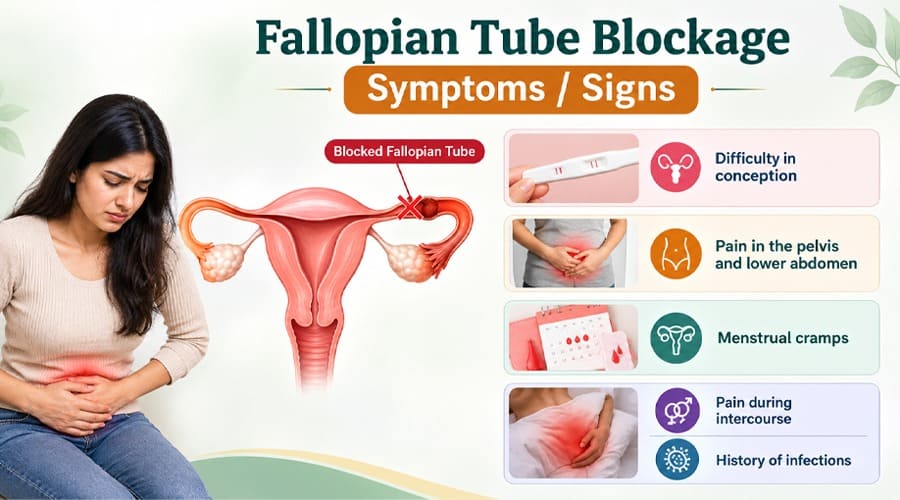
Usually, the signs of blocked fallopian tubes are not known until the woman faces problems getting pregnant. In certain cases, the tubal blockage may cause mild and continuous pain on one side of the abdomen.
Other signs of blocked fallopian tubes include low abdominal pain and vaginal discharge. Yet the symptoms of blocked fallopian tubes don’t need to be experienced by all women.
- Difficulty in conception: Inability to conceive within a period of one year after engaging in regular unprotected sexual activities.
- Pain in the pelvis and lower abdomen: There could be constant, dull, or one-sided pain in the lower part of the abdomen, especially if there is inflammation.
- Menstrual cramps: Menstrual cramps that are more painful than normal may indicate some reproductive problems.
- Pain during intercourse: This kind of pain may occur due to pelvic inflammation.
- History of infections: A history of pelvic inflammatory disease or sexually transmitted diseases.
Blocked Tubes can be Unblocked Naturally, but you need to understand that there are “No” visible signs of blocked fallopian tubes. If you don’t encounter the causes mentioned above, there is no other way to know that. This is because it is an internal issue; you can’t feel anything even if your tubes are blocked.
Then how can I know?
There is only one way to know the signs of blocked fallopian tubes, and that is if you’re having a problem conceiving. If you are not able to get pregnant even after trying everything, this can be your solution.
Here, Dr. Chanchal Sharma recommends an HSG Test to determine what is hindering your pregnancy.
What is the HSG test?
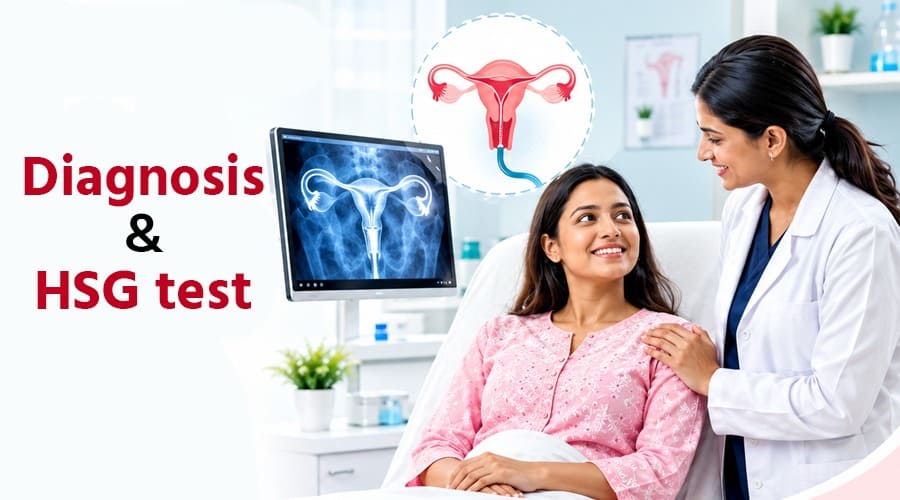
HSG, or Hysterosalpingogram, is a specialised fertility test that’s a unique X-ray that checks your uterus and fallopian tubes to make sure everything’s okay in there.
How does it work?
- Step 1: A doctor or radiologist gently inserts a small tube, or cannula, through the cervix.
- Step 2: A liquid contrast dye containing iodine is injected that fills the uterine cavity and flows into the fallopian tubes.
- Step 3: A series of X-ray images called Fluoroscopy is taken to see how the dye moves. This reveals whether everything is functioning correctly.
What does it show?
- Whether the tubes are open or blocked. If they’re open, the dye flows through and spills into the pelvic cavity.
- If they are blocked, the dye stops where the tube is obstructed.
- It also highlights any abnormalities, such as fibroids, polyps, or scarring, in the uterus.
An HSG usually takes 15 to 30 minutes and is typically done a few days after your period ends, before you ovulate. Many women feel cramps when the dye is injected, similar to strong menstrual cramps. But the discomfort usually goes away quickly after the test.
Treatment for Tubal Block
Now you know the disease, the cause, and how it is diagnosed. Coming to the solution, tube blockage treatment, it is divided into 3 types:
- Enhancing lifestyle and daily routine: Just taking medicines won’t give you the desired results. If you really want to conceive naturally, you need to follow a disciplined, structured routine.
- Anti-inflammatory diet: Consume foods with anti-inflammatory properties and antioxidants, such as turmeric, ginger, and citrus fruits rich in Vitamin C.
- Stopping unhealthy practices: Avoid smoking and alcohol since they can adversely affect your reproductive system and the function of the fallopian tubes.
- Mental health management: Your mind is an important aspect of your well-being, as Dr. Joseph Murphy, author of The Power of Your Subconscious Mind, wrote, “All disease originates in the mind. Nothing appears on the body unless there is a mental pattern corresponding to it.”
- Yoga/Meditation: Stress is another factor that causes hormonal imbalance. A regular 5-10 minutes of meditation can help reduce your stress. Certain yoga positions can help you with pelvic blood circulation.
- Pelvic/abdominal massage: Some specialists support the use of abdominal massages to increase blood circulation and reduce pelvic adhesions.
- Alternative Medicine and Traditional Approach: Some traditional practices, such as Uttar Basti, a technique where medicinal oils are gently introduced into the uterus, aim to eliminate tubal adhesions.
- Proven Medical Solutions: In severe cases of structural blockages, only medically backed solutions are preferred. Some of them include Fallopian Tube Recanalization and laparoscopy.
Why should you choose Ayurveda for Tube blockage treatment?
Dr. Chanchal Sharma, at Aasha Ayurveda Fertility Centre, believes in holistic and natural development rather than temporary treatment. For infertility treatment, Ayurveda works best because it doesn’t involve any heavy medication that comes along with side effects. Ayurveda incorporates natural alternatives that can heal your body, not only for a healthy conception but also to keep it healthy afterwards.
It is widely understood that Ayurveda works slowly and that results are not guaranteed, but from a broader perspective, even surgical treatment may result in conception failure. The word guarantee in itself is misleading when it comes to results. So don’t believe it when you read the word guarantee for your pregnancy. You can conceive only when you believe you can. If you don’t believe in yourself, no doctor or treatment can help you.
Coming back to Ayurveda for tube blockage treatment, yes, it works slowly, but you must have heard “slow and steady wins the race,” which correctly applies to this situation. Just because the process is slow, it doesn’t mean it doesn’t work. Ayurveda works miraculously for tube blockage treatment and may even produce astonishing results- that is, your natural pregnancy!
So don’t lose hope in yourself, because we believe in you.