
Home › Ayurveda Treatments › Fallopian Tube Blockage
Personalised Ayurvedic fertility care for women with low AMH, focused on ovarian health, reproductive wellbeing, lifestyle and individual conception goals.
✦ Low AMH Assessment ✦ Personalised Ayurvedic Care
✦ Diet & Lifestyle Guidance ✦ Fertility-Focused Support
Get an Appointment
AMH, or Anti-Müllerian Hormone, is produced by small follicles in the ovaries and is commonly used as one marker of ovarian reserve. A low AMH level may indicate a lower ovarian reserve, but it does not by itself mean that pregnancy is impossible.
Fertility is influenced by several factors, including age, ovulation, ovarian reserve, fallopian tube health, sperm factors and overall reproductive health. Therefore, an AMH report should always be interpreted in the context of the individual rather than viewed as a fertility result on its own.
Low AMH can be concerning when a woman is planning pregnancy, particularly when there are other fertility factors involved. It may help doctors understand how the ovaries could respond to fertility treatment, but AMH does not directly measure egg quality.
This is why treatment for low AMH to get pregnant should focus on the complete fertility picture rather than trying to change one laboratory number.
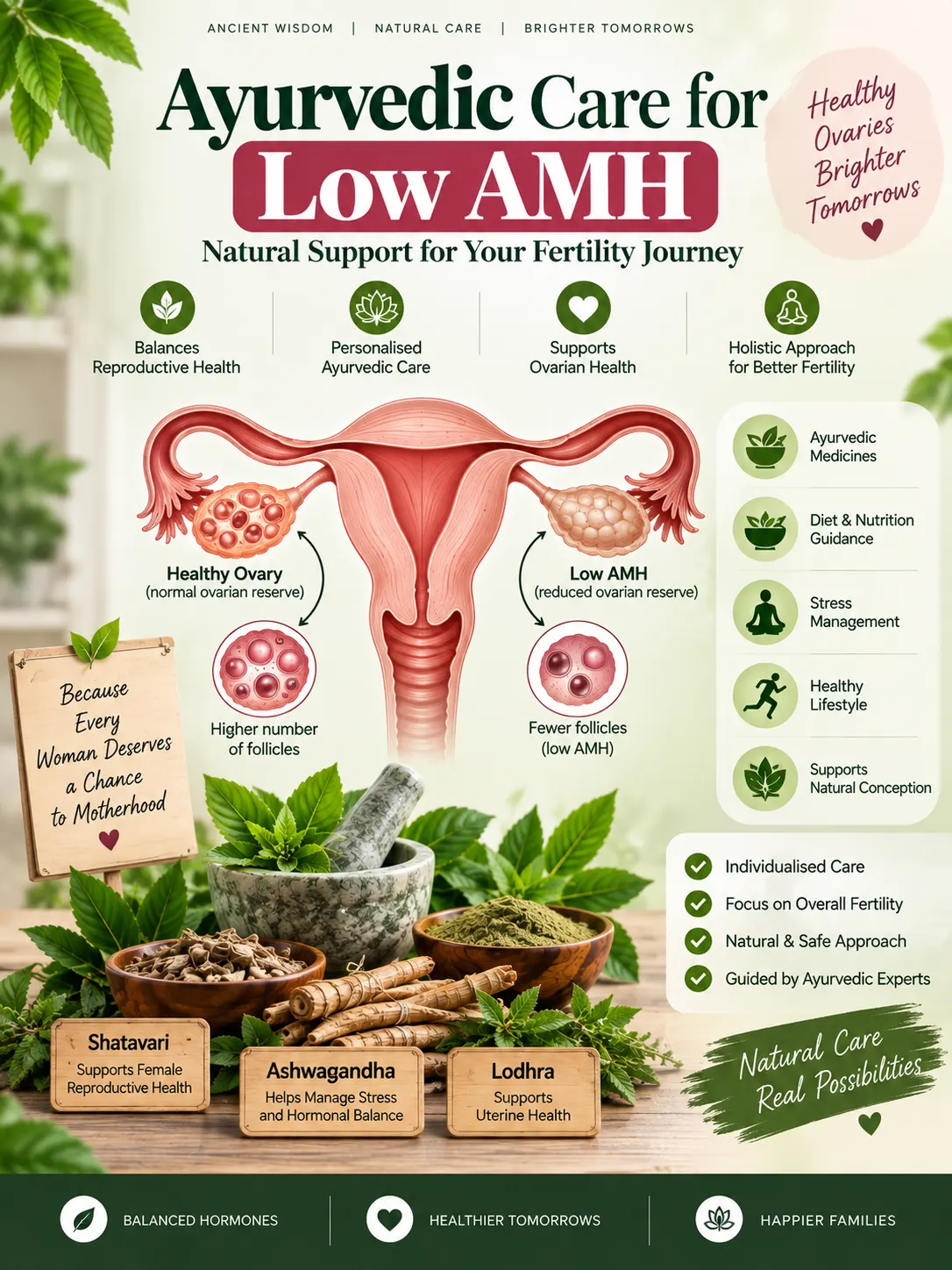
AMH naturally tends to decline with age as the ovarian follicle pool decreases. Other factors may also influence ovarian reserve or AMH measurements, including previous ovarian surgery, certain medical treatments and individual reproductive factors.
A low result should therefore be discussed with a qualified fertility professional rather than interpreted in isolation.
Women searching for how to increase AMH levels in Ayurveda often want to know whether Ayurvedic care can support ovarian health.
Ayurveda takes an individualised approach to fertility. Depending on the person’s health, menstrual history, digestion, nutrition, lifestyle and reproductive goals, an Ayurvedic practitioner may focus on supporting overall wellbeing through personalised diet, lifestyle measures, stress management, appropriate therapies and selected medicines.
However, there is currently no established Ayurvedic treatment that can guarantee an increase in AMH or restore ovarian reserve. The goal should be informed, personalised fertility support rather than focusing only on the laboratory value.
There is no single best Ayurvedic medicine for low AMH that is suitable for every woman. Ayurvedic medicines should be selected after considering age, menstrual pattern, medical history, current medicines and fertility plans.
Some published Ayurvedic case reports have described changes in AMH following individual treatment protocols, but these reports cannot establish that the same treatment will work for everyone.
For this reason, self-medication should be avoided, especially when trying to conceive.
Shatavari is traditionally used in Ayurveda in women’s reproductive health and fertility care. However, it should not be presented as a guaranteed way to increase AMH.
Whether Shatavari for fertility is appropriate depends on the individual’s health, medicines, pregnancy plans and overall fertility assessment. A qualified practitioner can advise whether it is suitable and how it should be used.
There is no universally appropriate dose of Shatavari powder for every woman. The amount and method of use may depend on individual health, digestion, medicines and fertility goals.
Instead of following a generic internet dosage, discuss how to use Shatavari powder for fertility with a qualified Ayurvedic practitioner.
When looking for how to improve low AMH naturally, focus on habits that support overall reproductive health rather than quick remedies.
A balanced diet, adequate protein and nutrients, regular physical activity, healthy sleep, stress management and avoiding smoking can contribute to general wellbeing. These habits are supportive, but they should not be described as proven methods to restore ovarian reserve.
If pregnancy is the goal, treatment planning should consider more than AMH. Age, menstrual and ovulatory status, ovarian reserve, fallopian tube health and the male partner’s fertility factors may all be relevant.
Some women with low AMH conceive naturally, while others may need fertility treatment. A low AMH result should not automatically be interpreted as an inability to conceive.
Explore personalised Ayurvedic care with Dr. Chanchal Sharma.
Book a consultation to discuss your concerns and understand your options.
Healthy nutrition, regular activity, adequate sleep and avoiding harmful lifestyle habits may support overall reproductive health. There is no guaranteed natural method for restoring ovarian reserve.
Infertility has many possible causes, so there is no single treatment that works for everyone. Ayurveda may be used as personalised fertility care, but guaranteed cure claims should be avoided.
There is no universally prescribed medicine that simply restores ovarian reserve. Treatment depends on the individual’s fertility assessment and pregnancy goals.
Ayurvedic care may focus on overall reproductive wellbeing, nutrition, lifestyle and individual treatment planning. An increase in AMH should not be guaranteed.
The appropriate amount and method can vary between individuals. Consult a qualified Ayurvedic practitioner before using Shatavari, particularly when trying to conceive.
There is not enough evidence to describe Shatavari as a proven AMH-raising treatment. It may be considered as part of personalised Ayurvedic care when appropriate.
Low AMH can be an important part of fertility assessment, but it is not the whole fertility picture. Low AMH treatment medicine should therefore focus on personalised care, reproductive health, healthy lifestyle habits and realistic fertility planning rather than promising a particular AMH increase or pregnancy outcome.
Medical Disclaimer: This content is for general educational purposes only and does not replace personalised medical diagnosis or treatment. Do not start Ayurvedic medicines or supplements without appropriate professional advice, particularly when planning pregnancy or undergoing fertility treatment.